Post-Pandemic Global Trade: Resilience Through Regionalization and Digital
Post-Pandemic Global Trade: Resilience Through Regionalization and Digital Acceleration – Vulnerabilities Remain
The COVID-19 pandemic did not merely disrupt global trade—it exposed the brittle architecture of a system built on hyper-efficient, lean supply chains. In 2020, global trade volumes plunged by 5.3%, the sharpest contraction since the 2008 financial crisis. Yet beneath that headline statistic, a more nuanced story unfolded: the emergence of two powerful and often contradictory forces—regionalization and digital acceleration—that are reshaping the way goods, services, and data flow across borders. While these twin dynamics have injected new resilience into the global trading system, deep vulnerabilities remain, threatening the stability of recovery for both developed and developing economies.
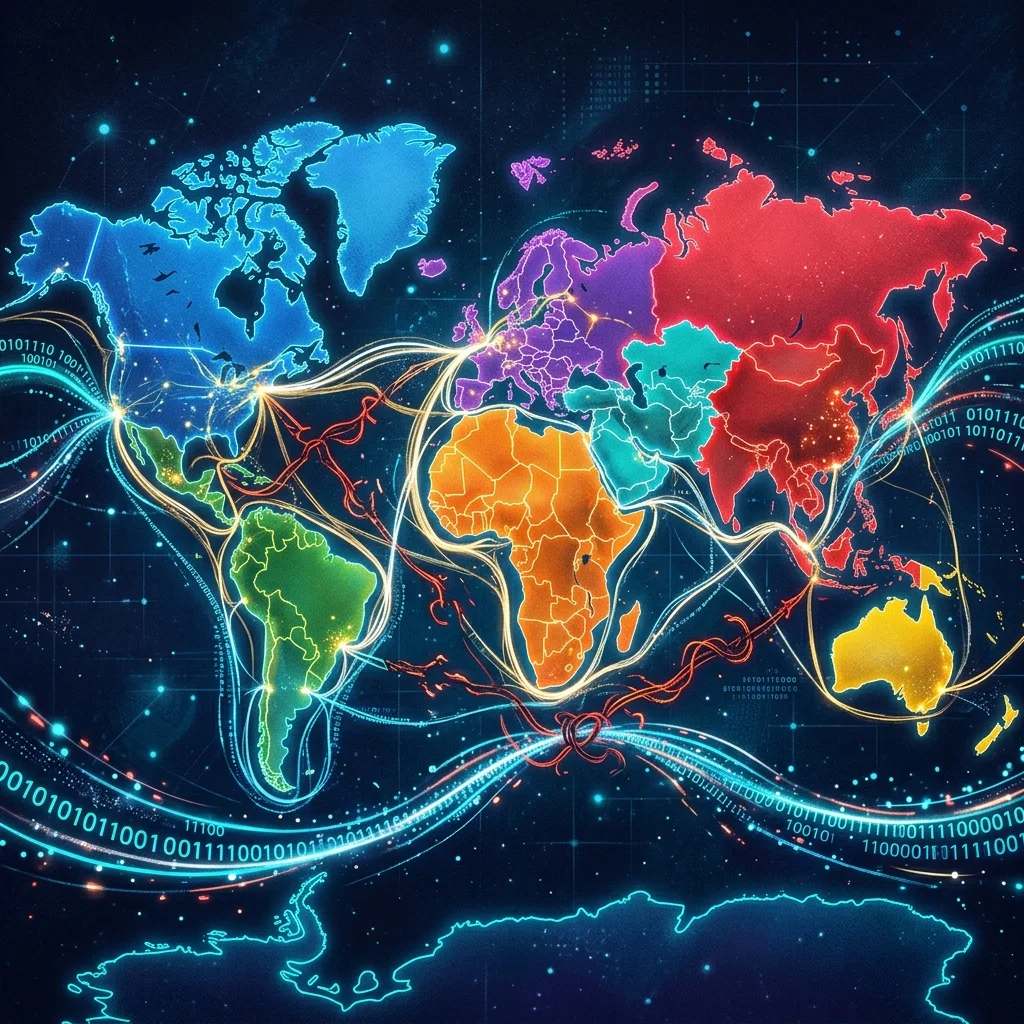
[IMAGE: Abstract illustration of interconnected global trade routes, with some routes broken or tangled, while digital data streams (binary code) flow around them. A map with regional blocs highlighted in different colors. No text, no watermark.]
The Shock: Pandemic Disruptions Expose Fragile Supply Chains
Before COVID-19, the dominant paradigm of global trade was "just-in-time" (JIT) manufacturing—an approach that minimized inventory costs by relying on precise, cross-border coordination. The pandemic shattered this model overnight. At the height of the crisis, manufacturing centers in China experienced a drop of approximately 13.5% in production, according to BBC News, as lockdowns halted factories and severed critical links in automotive, electronics, and medical supply chains. The ripple effects were immediate and global.
The Port of Los Angeles, a gateway for about 40% of all containerized imports into the United States, saw a 25% increase in waiting times for ship docking, as reported by the Los Angeles Times. Congestion cascaded across the Pacific, leaving containers stranded and retailers scrambling for empty vessels. The World Trade Organization (WTO) recorded a 5.3% decline in global trade volumes in 2020, a drop that was both sudden and uneven: trade in medical goods surged, while travel, tourism, and non-essential manufacturing collapsed.
[IMAGE: Graph of global trade volume decline or a photograph of container ships waiting at a port.]
The pandemic revealed how supply chain resilience had been sacrificed for cost efficiency. Single-source dependencies—especially on China for raw materials, components, and finished goods—became critical bottlenecks. Companies that had diversified little beyond one or two manufacturing hubs faced weeks-long production halts. The shock was not only economic but also strategic: governments realized that trade vulnerabilities extended beyond market access to encompass national security, public health, and food security.
The Policy Response: Protectionism and Regional Integration
In the immediate aftermath of the disruption, nations turned inward. Over 93 countries adopted trade-restrictive measures during the pandemic, according to the Global Trade Alert database. These included export bans on medical supplies, new tariffs, and regulatory hurdles designed to prioritize domestic industries. Protectionism spiked as governments scrambled to secure essential goods.
Yet paradoxically, the same crisis accelerated the consolidation of regional integration. Two major blocs—the Regional Comprehensive Economic Partnership (RCEP) and the African Continental Free Trade Area (AfCFTA)—gained significant momentum. RCEP, signed in November 2020, encompasses 15 Asia-Pacific nations and accounts for about 30% of global GDP, according to the Brookings Institution. It creates the world’s largest free trade area by economic output, reducing tariffs and harmonizing rules of origin across a region that already represents the engine of global manufacturing.
In Africa, the AfCFTA began trading in January 2021 after years of negotiations. The United Nations Economic Commission for Africa (UNECA) projects that the pact could increase intra-African trade by 52% by 2022 (later updated to 25-30% due to pandemic delays). By lowering barriers within the continent, AfCFTA offers the promise of shorter, more resilient supply chains that bypass the vulnerabilities of long-distance, single-source dependency.
[IMAGE: World map highlighting RCEP and AfCFTA member countries in distinct colors.]
These regional blocs are not just about tariff reduction; they are strategic responses to the fragility exposed by COVID-19. Regionalization allows companies to source from neighboring countries, reducing lead times and exposure to geopolitical disruptions. It also enables governments to coordinate supply chain resilience policies, such as stockpiling critical goods and establishing mutual recognition of standards. However, the growth of regionalism also raises the risk of fragmentation: as trade flows shift toward blocs, global multilateral frameworks like the WTO risk being sidelined, creating a patchwork of rules that may complicate global trade for smaller players.
The Digital Surge: E-Commerce as a Trade Lifeline
While physical supply chains struggled, digital channels exploded. The pandemic forced consumers and businesses to pivot online, accelerating a trend that had been simmering for years. According to UNCTAD, e-commerce’s share of the global retail market rose from 14% in 2019 to roughly 17% in 2020—a jump of three percentage points in a single year, representing hundreds of billions of dollars in additional digital trade.
The shift was especially pronounced in North America. The U.S. Census Bureau reported a 44% spike in e-commerce sales in 2020, as lockdowns shuttered brick-and-mortar stores and households turned to online ordering for everything from groceries to electronics. Amazon, the dominant player, recorded a 27% increase in Q1 2020 revenues, as reported in its press release, and the company added more than 175,000 new employees to meet surging demand.
[IMAGE: Bar chart showing e-commerce share growth from 2019 to 2020 and regional sales spikes.]
E-commerce became a lifeline not only for consumers but also for small and medium-sized enterprises (SMEs) that had previously relied on physical retail or cross-border trade shows. Platforms like Shopify, Alibaba, and Mercado Libre enabled businesses to bypass traditional intermediaries and reach international customers directly. Cross-border e-commerce grew at double-digit rates, fueled by digital payment systems, improved last-mile logistics, and the expansion of digital trade infrastructure such as cloud computing and big data analytics.
Yet the digital surge also exposed a digital divide. Developing economies, where internet penetration remains low and logistics infrastructure weak, missed out on much of this growth. UNCTAD’s 2021 report noted that the share of e-commerce in retail varied from less than 2% in some African countries to over 30% in China and South Korea. The acceleration of digital trade thus widened the gap between digitally advanced nations and those still struggling with basic connectivity, creating a new dimension of trade vulnerabilities.
The New Balance: Resilience Through Hybrid Supply Chains
As the pandemic receded, a new consensus emerged: the old "just-in-time" model was insufficient, but a complete retreat to "just-in-case" inventory hoarding was also unsustainable. Instead, companies began building hybrid supply chains that blend efficiency with redundancy.
The shift from 'just-in-time' to 'just-in-case' involves holding higher safety stocks, diversifying suppliers across multiple regions, and investing in nearshoring or friendshoring—relocating production to geopolitically aligned countries or neighboring economies. Toyota, for example, increased its inventory of critical semiconductor parts after shortages halted production lines globally. Apple and other electronics manufacturers moved some assembly from China to India, Vietnam, and Mexico.
Regional integration blocs like RCEP and AfCFTA provide the institutional frameworks for these shorter, more resilient supply chains. By reducing tariffs and simplifying customs procedures within a bloc, they lower the cost of sourcing from nearby countries. A company operating in Southeast Asia can now source components from RCEP members with fewer barriers, reducing the risk of disruption from a single distant supplier.[IMAGE: Diagram contrasting 'just-in-time' vs 'just-in-case' supply chain models with regional hubs.]
Digital tools are the second pillar of this new resilience. IoT sensors track shipments in real time, AI algorithms predict demand fluctuations and flag potential bottlenecks, and blockchain ensures transparency and trust across multi-party supply chains. A 2022 McKinsey survey found that 65% of supply chain executives had accelerated investments in digital technologies during the pandemic. These tools enable supply chain resilience not only by reducing uncertainty but also by allowing companies to pivot quickly when disruptions occur—rerouting shipments, swapping suppliers, or adjusting inventory allocations.
The result is a global trading system that is more adaptive but also more complex. The post-pandemic economy is characterized by multiple, overlapping networks: regional blocs for physical goods, digital platforms for services and data, and a renewed emphasis on strategic autonomy for critical sectors like semiconductors, pharmaceuticals, and energy.
Persistent Vulnerabilities: What Remains Fragile?
Despite these advances, significant trade vulnerabilities persist. The most stubborn is over-reliance on a few manufacturing hubs. Despite diversification efforts, China remains the factory floor for the world, producing about 30% of global manufacturing output. In sectors like rare earths, pharmaceuticals, and electronics, concentration is even higher. While RCEP encourages intra-regional trade, it also locks China into a dominant position within the bloc, raising concerns about leverage and dependency.
Another critical fragility is the digital divide. The acceleration of e-commerce and digital trade has bypassed large swaths of Sub-Saharan Africa, South Asia, and Latin America, where internet access, digital literacy, and payment infrastructure lag. Without targeted investment in connectivity and digital skills, these regions risk being excluded from the digital trade boom, deepening inequality and reducing their ability to participate in global trade resilience.
[IMAGE: Illustration of a fragmented globe with weak links, representing ongoing vulnerabilities.]
Geopolitical tensions add further uncertainty. The U.S.-China trade war, which began before the pandemic, has escalated into a broader contest over technology, supply chains, and standards. New trade barriers—such as tariffs on semiconductors, export controls on advanced chips, and restrictions on data flows—are fragmenting the global market. The WTO’s dispute settlement system remains paralyzed, making it harder to enforce rules. As regional blocs solidify, the risk of "decoupling" becomes real: the world could split into competing spheres of influence, with different technical standards, payment systems, and supply chains.Finally, the pandemic-era protectionism has not fully receded. Many trade-restrictive measures enacted in 2020 remain in place, and new ones have appeared in response to food and energy shortages triggered by the war in Ukraine. The Global Trade Alert reports that trade interventions have actually increased since the pandemic, with a cumulative stock of over 3,000 harmful measures still active. This "policy drift" undermines the predictability that businesses need for long-term investment in supply chain resilience.
Conclusion: A More Resilient but Uneven Trade Future
The COVID-19 pandemic was a stress test that revealed both the strengths and weaknesses of global trade. The rapid shift toward regionalization and digital acceleration has made supply chains more resilient in some respects: shorter distances reduce exposure to global shocks, and digital tools enable real-time adaptation. RCEP and AfCFTA represent bold steps toward building robust regional frameworks that can cushion against future crises.
Yet the same forces that build resilience also introduce new fragilities. Protectionism has not disappeared; it has evolved, taking the form of regional preferences and technology controls. The digital divide threatens to leave a large part of the world behind. Geopolitical tensions risk fragmenting the global economy into rival blocs. And the over-reliance on concentrated manufacturing hubs remains an unresolved challenge.
The post-pandemic economy will not return to the hyper-globalized, friction-free trade of the 2010s. Instead, it will be a hybrid system: more regional and digital, but also more uneven and contested. The challenge for policymakers and businesses is to manage this transition deliberately—investing in connectivity, diversifying strategically, and maintaining a commitment to multilateral rules even as regional blocs gain prominence. Only by addressing both the new resilience and the persistent vulnerabilities can the world build a trade system that is truly prepared for the next shock.
Commerce Advisory Notice
Commerce, logistics and retail analysis is provided for general business information. Market conditions and operating requirements vary, and the content is not professional operational, legal or investment advice.

About Helena Rossi
Helena Rossi provides deep-dive analysis on EU trade regulations, ESG mandates, and global tariff frameworks from our Brussels bureau.
View all articles by Helena Rossi →